PPI doesn’t measure what you think
Macro
PPI (kinda) leads CPI
This past weekend the host of my favorite pure macro podcast said something to the tune: PPI leads CPI since PPI measures what businesses pay, which then make their way into consumer prices.
Not quite.
From the BLS: “The Producer Price Index (PPI) of the Bureau of Labor Statistics (BLS) is a family of indexes that measures the average change over time in prices received (price changes) by producers for domestically produced goods, services, and construction.” The colloquial “PPI” is the PPI-FD, where FD stands for Final Demand. From the same BLS report we see that: “The final demand goods index measures price change for both unprocessed and processed goods sold to final demand. Fresh fruits sold to consumers and computers sold for capital investment are examples of transactions included in the final demand goods price index.” Other PPI-FD components are defined similarly.
Meanwhile, according to the BLS the CPI measures: the change in prices paid by consumers for goods and services.
PPI = prices RECEIVED by sellers | CPI = prices PAID by consumers
Contrary to what the podcast host said, the PPI-FD is not necessarily the price of inputs into the prices of products that consumer purchase.
Let’s look at the empirical data to see if PPI leads CPI. First I transform the indices into m/m % Deltas to encourage stationarity. Then I construct a CCF.
Each bar on the CCF is cor(PPI_{t-k},CPI_{t}). Negative lags track whether PPI LEADS the CPI.
The fact that there are significant (above blue dashed line) bars on either side of 0 implies there is a simultaneous temporal feedback. i.e. PPI leads and lags CPI.
There are many definition differences between the CPI and PPI-FD. For instance, PPI-FD tracks more than just consumer goods. It also tracks the prices received for the sale of capital investment, government, and export products. We can narrow in on the personal consumption component of PPI-FD.
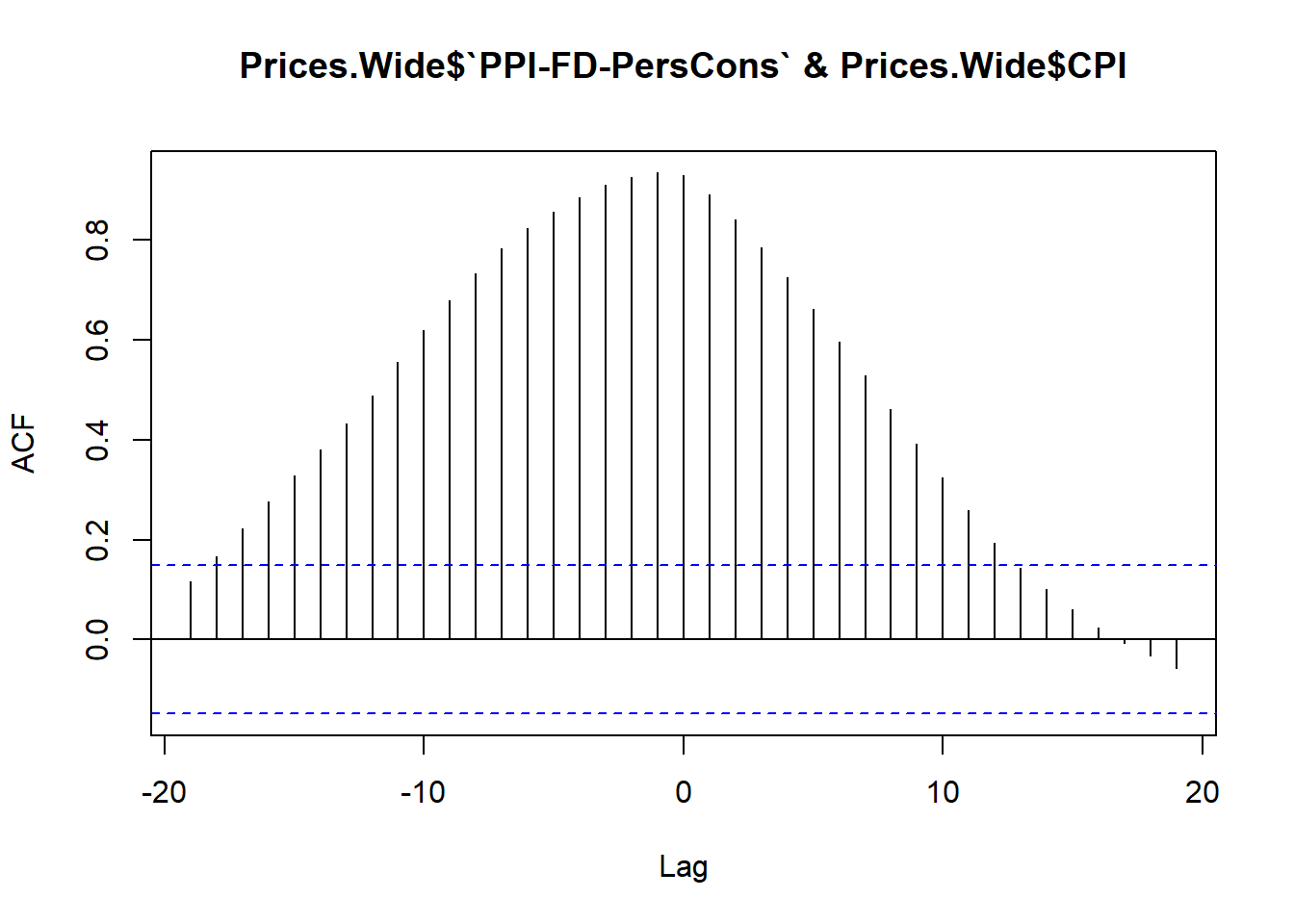
The bi-directionality holds. These results support this 2014 BLS report.
I think what the podcast hist was searching for was actually a group of PPI’s that track inputs. One such grouping are the PPI-ID (Intermediate Demand). As per this BLS report: “The intermediate demand portion of the FD-ID system tracks price change for goods, services, and construction products sold to businesses as inputs to production, excluding capital investment.” These PPI-IDs are split into Goods (Processed and Unprocessed) and Services. Here are the ccf’s for each.
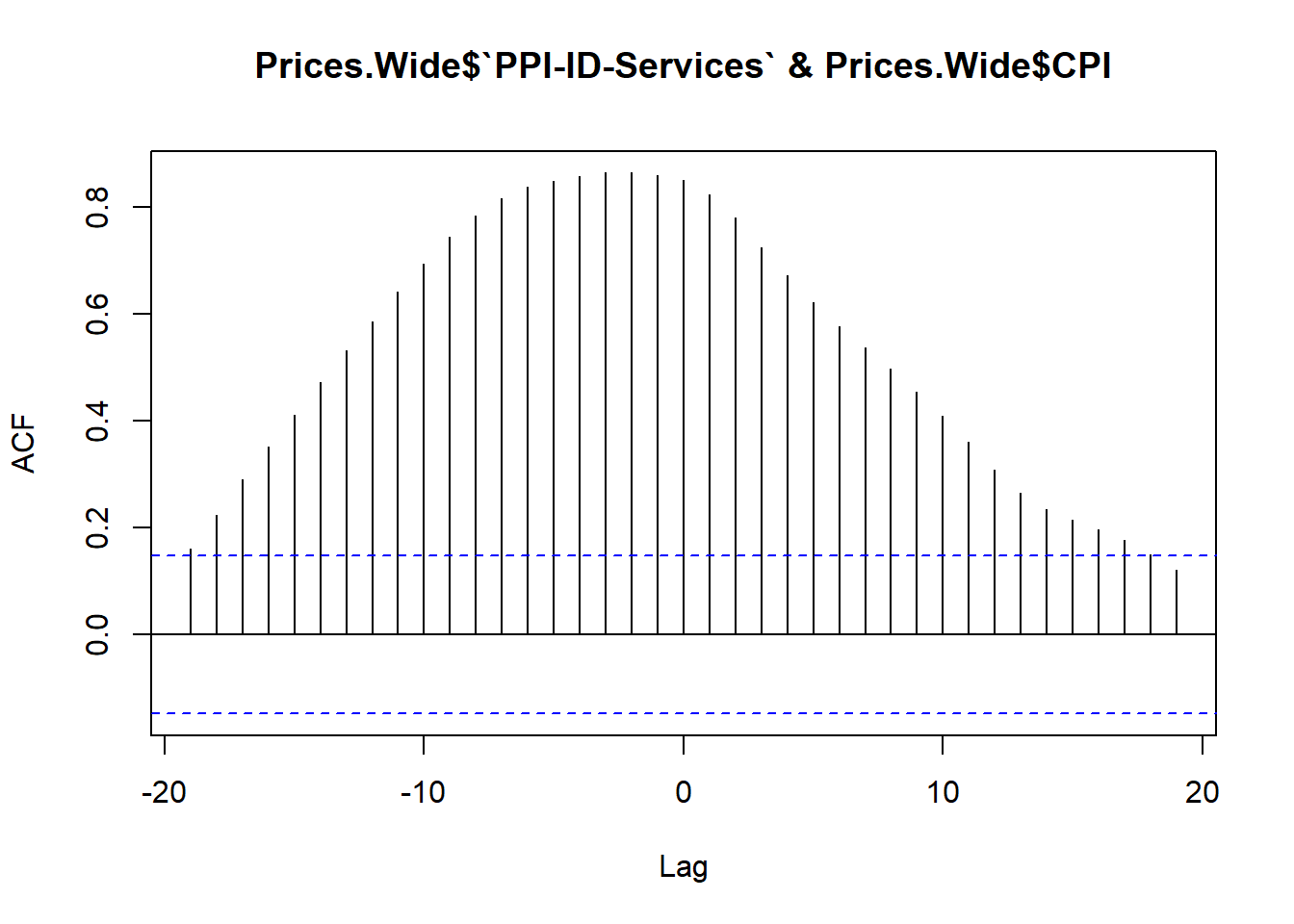
We can see that PPI-ID services has a similar bidirectional relationship to CPI [CPI roughly 60% services].


Notice the clear asymmetry in these CCF’s. Intermediate demands good LEADS the CPI.
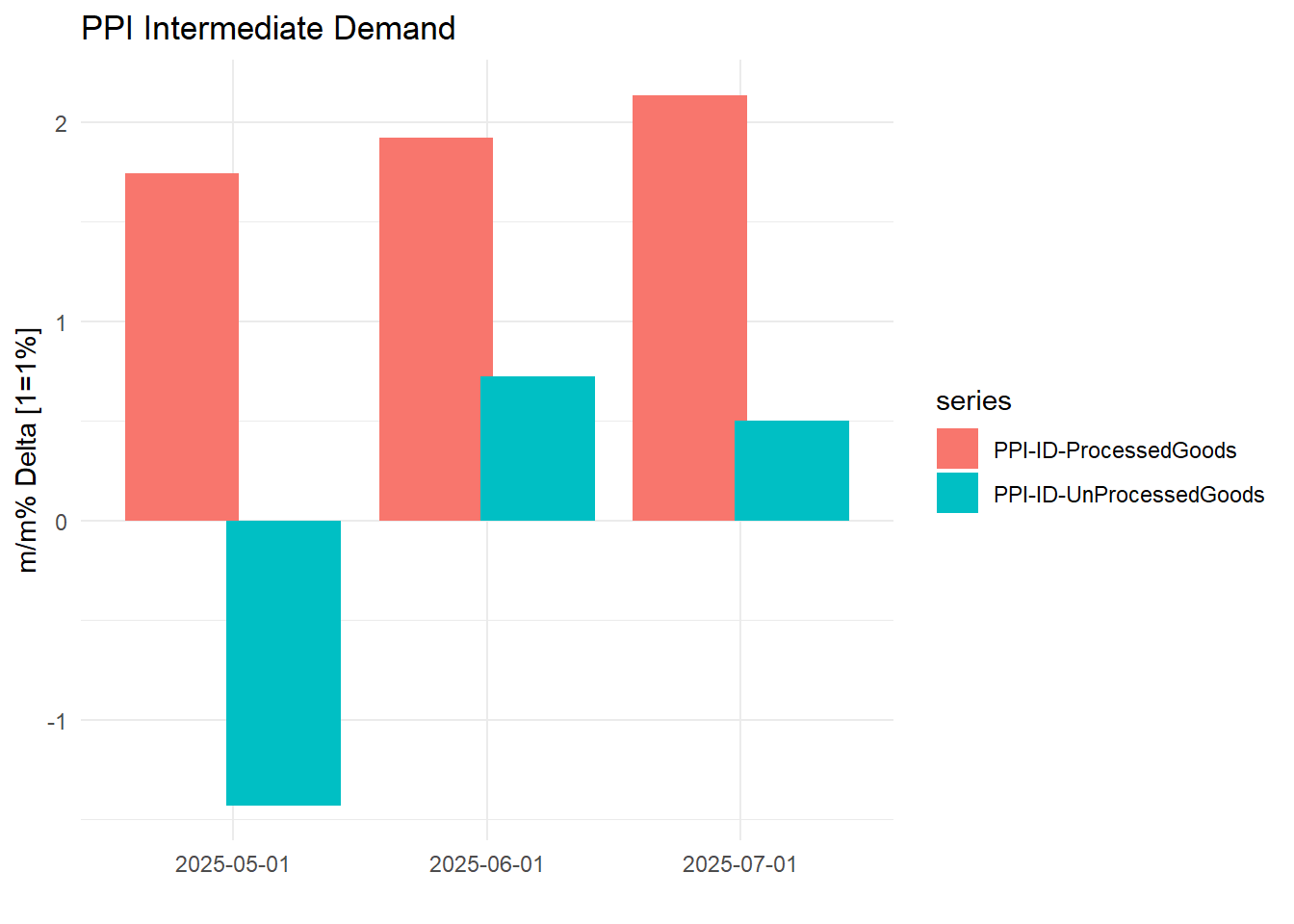
In recent months Intermediate Demand PPI Goods, both processed and unprocessed, are on the rise, which suggests upward pressure on future CPI.